Last updated: June 2026
Countertops are the most visible surface in the kitchen — and the one with the widest legitimate price range of any single home improvement purchase. Laminate countertops cost $15–$40 per square foot installed. Granite runs $40–$100. Quartz lands at $50–$120. Quartzite and marble push to $70–$200+. For a typical kitchen with 30 square feet of countertop surface, that’s the difference between a $450 project and a $6,000 project — for materials that all do the same basic job of providing a work surface.
What most homeowners don’t understand until they’re deep in quotes: the countertop material is rarely the most expensive part of the decision. Sink cutouts, edge profiles, backsplash integration, removal of existing countertops, and plumbing reconnection regularly add $500–$2,000 to a project that looked simple on paper. This guide covers every cost factor so you know exactly what fair looks like before you walk into a single showroom.
Kitchen Countertop Cost by Material
| Material | Cost per Sq Ft | 30 sq ft Total | Durability |
|---|---|---|---|
| Laminate | $15–$40 | $450–$1,200 | 10–20 years |
| Tile | $20–$50 | $600–$1,500 | 20–30 years |
| Butcher block / wood | $30–$70 | $900–$2,100 | 20+ years (with oiling) |
| Granite | $40–$100 | $1,200–$3,000 | Lifetime (with sealing) |
| Quartz (engineered) | $50–$120 | $1,500–$3,600 | Lifetime (no sealing) |
| Marble | $60–$150 | $1,800–$4,500 | Lifetime (high maintenance) |
| Quartzite / natural stone | $70–$200+ | $2,100–$6,000+ | Lifetime |
Use Our Free Kitchen Countertop Cost Calculator
Enter your kitchen dimensions and material choice to get an instant estimate. The calculator accounts for square footage, edge profile, sink cutout, and installation labor.
Kitchen Countertop Cost Calculator
Granite vs. Quartz vs. Laminate — The Honest Comparison
The countertop material decision drives more analysis paralysis than almost any other kitchen choice. Here’s the straightforward breakdown without the showroom spin.
Quartz — Why It Dominates the Market in 2026
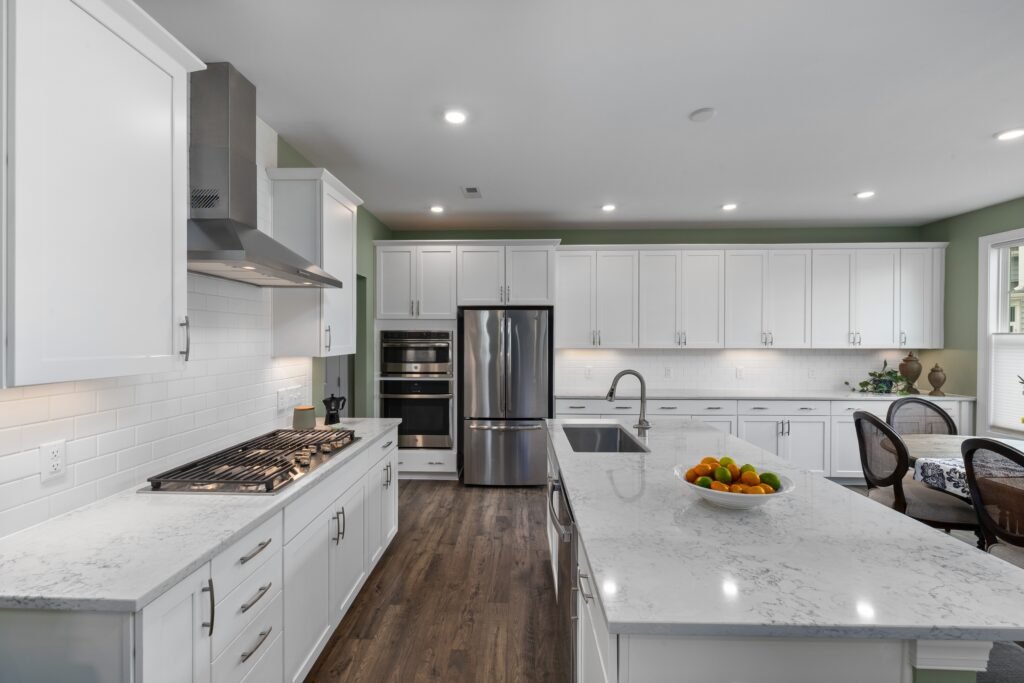
Engineered quartz — made from 90-95% crushed quartz bound with resin — has become the dominant premium countertop choice in the US for good reason. At $50–$120 per square foot installed, it costs more than granite on average but delivers advantages that justify the premium for most homeowners: it requires no sealing (ever), resists staining from wine, coffee, and acidic foods better than natural stone, and offers completely consistent color and pattern across slabs — no surprises when the fabricator cuts your specific pieces.
Brands like Silestone, Caesarstone, Cambria, and MSI Q Premium have become the standard specification in mid-to-high-end kitchen renovations. The practical limitation: quartz can be damaged by heat — setting a hot pan directly on quartz can cause discoloration from the resin binder. Always use trivets. Quartz also doesn’t do well in outdoor kitchens where UV exposure degrades the resin over time.
Granite — Still Excellent, Often Better Value
Granite has been somewhat overshadowed by quartz in recent years, but it remains an excellent material at often better pricing — particularly for homeowners who like natural stone’s variation and uniqueness. At $40–$100 per square foot installed, entry-level granite is frequently less expensive than comparable quartz while delivering similar durability and a genuinely natural aesthetic that engineered materials can’t replicate.
The maintenance reality: granite requires sealing every 1–3 years with a penetrating stone sealer — a $20–$30 DIY task that takes 20 minutes and is straightforward enough that most homeowners do it themselves without issue. Unsealed granite can absorb stains, particularly from oil and acidic liquids. The reputation for being high-maintenance is somewhat overstated — properly sealed granite is very practical for everyday kitchen use.
Granite’s advantage over quartz: it’s genuinely heat-resistant (you can set hot pans on it without damage) and each slab is unique. If you’re looking at two kitchens with similar granite and similar quartz and the granite is $500–$1,000 less for the same square footage, it’s often the better value choice.
Laminate — The Underrated Comeback Story
Laminate countertops have shed their dated reputation in 2026 — modern high-definition laminate like Wilsonart HD, Formica 180fx, and Nevamar convincingly mimics granite, quartz, and wood grain at $15–$40 per square foot installed, roughly one-third the cost of natural stone. For homeowners who update their kitchens every 10-15 years anyway, laminate’s lower lifespan is irrelevant — the savings fund the next update.
Laminate’s practical limitations remain real: it can’t be repaired if cut or burned (unlike stone which can be polished), the seam at the sink is a permanent vulnerability to water damage, and very close inspection reveals it’s not stone. For rental properties, vacation homes, and homeowners prioritizing function over status, laminate is a genuinely smart choice that most kitchen designers won’t push because the margins are lower.
Butcher Block — The Right Choice in the Right Kitchen
Butcher block and solid wood countertops cost $30–$70 per square foot installed and offer something no other material does: they can be sanded and refinished repeatedly to remove scratches, stains, and damage, essentially resetting the surface. This makes them the most repairable countertop material available.
The maintenance commitment is real — oiling with food-grade mineral oil every 1–3 months is required to prevent drying and cracking. They’re vulnerable to standing water at the sink area, and areas around undermount sinks require particularly careful sealing and maintenance. Many designers use butcher block for the island and stone or quartz for perimeter counters — getting the warmth and functionality of wood where it’s most useful while keeping easier-care material at the primary work areas. For a complete kitchen remodel cost breakdown, butcher block islands are worth considering as a cost-effective premium element.
Marble — Beautiful but Demanding
Marble is the aspirational choice that looks extraordinary in magazine kitchens and requires more patience than most homeowners have in a working kitchen. At $60–$150 per square foot, it’s priced at the premium tier — and it etches (loses surface polish) when it contacts acidic substances like lemon juice, wine, or vinegar, which describes a typical cooking session.
Marble in kitchens develops a patina over time that some owners find beautiful and characterful and others find deeply frustrating. If you’re the type of homeowner who would be bothered by the first etch mark from a glass of orange juice, marble is genuinely not the right kitchen countertop material regardless of how beautiful it looks in the showroom. Bathrooms — where acid exposure is minimal — are a much better application for marble’s aesthetic at lower maintenance cost. See our bathroom remodel cost guide for how marble fits into bathroom renovations.
What Drives Countertop Costs Beyond Material
1. Fabrication and Installation — The Hidden Labor Cost
The material price per square foot that showrooms advertise rarely includes fabrication and installation — and these costs are substantial for stone. Stone countertops must be templated (a technician visits and creates a precise template of your cabinets), cut to fit by a fabricator using diamond-tipped saws, and installed by a crew who lifts 200–400 lb slabs into position.
Fabrication and installation typically adds $10–$25 per square foot to material cost for stone — for a 30 sq ft kitchen, that’s $300–$750 in labor on top of material. Some companies include installation in their quoted price; others separate it. Always ask: “Is this price including templating, fabrication, and installation?” before comparing quotes.
2. Sink Cutout and Type
Every countertop that includes a sink requires a cutout — and the type of sink you choose significantly affects countertop cost and installation complexity. A drop-in sink (drops into a hole cut in the countertop) has the simplest cutout and costs $50–$150 extra to cut. An undermount sink (mounts beneath the counter for a seamless look) requires a finished edge around the cutout — more precise work that costs $150–$300 extra and is the standard choice for stone countertops. A farmhouse/apron sink requires cabinet modification in addition to countertop work, adding $200–$500 to the project.
3. Edge Profile — Where Countertops Get Expensive Quickly
The edge profile — how the countertop edge is finished — is one of the more significant cost variables that homeowners overlook when getting initial quotes. A simple eased edge (slightly softened square edge) is typically included in the base price. A bullnose (fully rounded) or beveled edge adds $10–$20 per linear foot. A decorative ogee (S-curve) profile adds $20–$30 per linear foot. A waterfall edge — where the countertop material continues vertically down the cabinet side — adds $400–$800+ and requires additional material.
For a 15-foot kitchen counter with an ogee edge, the edge upcharge alone adds $300–$450 to the project. Know your edge preference before getting quotes so you’re comparing identical specifications.
4. Old Countertop Removal
Removing existing countertops costs $100–$300 for laminate or tile, and includes disconnecting the sink plumbing. Plumbing reconnection after new countertops install costs $150–$300 for a plumber to reconnect the sink drain and supply lines. Many countertop installers handle this, others require a separate plumber visit — confirm what’s included before signing.
5. Backsplash Decisions
Countertop replacement often reveals unfinished or outdated wall surfaces behind the old countertop — creating an immediate backsplash decision. A basic kitchen backsplash installation adds $400–$1,500 but dramatically improves the finished look. Doing backsplash and countertops together is almost always more efficient than two separate projects — the wall area is already exposed and the installer is already on-site.
Countertop Buying Strategy — Getting the Best Price
Countertops are a category where buying strategy significantly affects what you pay. Stone slab pricing in particular varies enormously between suppliers, and the same material from different sources can differ by 30–50%.
- Visit stone yards directly — rather than buying through a kitchen designer or big box store, visit local stone fabricators and wholesalers. You’ll see the actual slabs you’re buying and typically pay 20–30% less than through a middleman.
- Consider remnant slabs — fabricators have remnants (leftover pieces from larger jobs) that work perfectly for smaller kitchens or islands at 40–60% off full slab pricing. Ask any fabricator about remnants before ordering full slabs.
- Get 3 quotes from fabricators — not from retailers. The same material from three local fabricators regularly varies by $500–$1,500 for an identical job.
- Choose a less exotic stone — common granite colors (Santa Cecilia, Uba Tuba, Venetian Gold) cost $40–$60 per square foot installed while rarer patterns run $80–$120. The durability is identical — you’re paying for rarity and aesthetics.
- Consider laminate for rentals and flips — if you’re renovating a rental property or a home to sell quickly, high-quality laminate at $1,200 instead of granite at $3,000 for the same kitchen captures most of the buyer appeal at one-third the cost.
Countertop Trends Worth Knowing in 2026
The dominant aesthetic in 2026 kitchen countertops is light and minimal — white and light gray quartz with subtle veining continues to dominate new kitchen installations, moving away from the darker granite and heavy-veined marble that dominated the 2010s. Warm tones are returning — creamy whites, warm beiges, and soft gold veining have replaced the cool stark whites that peaked around 2018-2022.
Dekton — an ultracompact surface made from a blend of raw materials used to produce glass, porcelain, and quartz — is growing in popularity as a premium option. At $65–$150 per square foot, it offers superior heat and scratch resistance compared to quartz, works for outdoor kitchens where quartz doesn’t, and comes in very large format slabs that minimize seams. It’s worth comparing against quartz if your budget extends to the premium tier.
Porcelain slab countertops — large-format porcelain tile (not traditional tile but sintered stone slabs) — are gaining traction as an alternative to natural stone at $40–$80 per square foot. They’re nearly impossible to stain or scratch, require no sealing, and can be produced in very large format with minimal visible seams. The aesthetic limitation is that porcelain, while convincing in photos, doesn’t have the depth and variation of natural stone up close.
Frequently Asked Questions About Kitchen Countertop Cost
How long does countertop installation take?
Templating (measuring) takes 30–60 minutes and is done 1–2 weeks before installation while the countertops are fabricated. Installation day takes 4–8 hours for a typical kitchen — removing old countertops, setting new ones, and completing the sink cutout connection. You’ll be without a kitchen sink for 24–48 hours while adhesive and caulk cure. Stone countertops are typically ready to use the next day.
What is the most durable kitchen countertop material?
For everyday kitchen durability, quartz and granite top the rankings — both are effectively indestructible under normal kitchen use. Quartz edges out granite slightly for stain resistance without sealing. Dekton and porcelain slab offer even greater heat and scratch resistance for homeowners who want the absolute most durable surface available. Marble, despite being natural stone, is the least durable premium option due to etching from acids common in kitchen environments.
Can I install countertops myself?
Laminate countertops — particularly post-form laminate (the type with the backsplash already attached) — are a realistic DIY project that can save $200–$400 in labor. Stone countertop installation is not DIY-accessible for most homeowners — the slabs weigh 200–400 pounds, require specialized lifting equipment, and improper installation can crack the stone. Butcher block installation is a feasible DIY project if you’re comfortable with basic carpentry.
How much do quartz countertops cost compared to granite?
Quartz typically costs $10–$20 per square foot more than comparable-tier granite — for a 30 sq ft kitchen, that’s $300–$600 more for quartz. The premium buys you no-seal maintenance, better stain resistance, and color consistency. Whether that’s worth it depends on your priorities — both materials will look great and last a lifetime with proper care.
Do new countertops increase home value?
Yes — kitchen countertop replacement is one of the higher-ROI kitchen improvements, typically recouping 60–80% of cost at resale. More importantly, dated or damaged countertops are among the first things buyers notice during kitchen walkthroughs and can affect offers. Upgrading from laminate to stone or quartz in a home being prepared for sale typically returns more than the upgrade cost in improved sale price and faster sale time, particularly in markets where stone countertops are the expected standard.
How do I choose between granite and quartz?
Choose quartz if: you want zero maintenance sealing, you cook with a lot of acidic ingredients, you want consistent color across the entire counter, or you have young children and want maximum stain forgiveness. Choose granite if: you want natural stone’s unique variation, you regularly set hot pans directly on the counter, or you find a granite slab you love that’s meaningfully less expensive than comparable quartz. Both are excellent long-term choices — the decision usually comes down to aesthetics and specific lifestyle factors rather than one being objectively superior.
What countertop thickness should I choose?
Standard stone countertop thickness is 3/4 inch (2cm) or 1.25 inches (3cm). The 3cm thickness is increasingly the standard for kitchen installations — it looks more substantial, requires no laminated edge to appear thick, and is structurally stronger. The 2cm option requires an eased edge treatment to appear full-thickness and is best suited for applications where weight is a concern. Most fabricators will recommend 3cm for kitchens — the price difference is typically $5–$10 per square foot and worth it for the appearance.
Should I replace countertops before or after painting cabinets?
Replace countertops after painting cabinets — cabinet painting involves sanding, priming, and spraying that generates dust and overspray that lands on every surface. New countertops installed before painting will need to be protected with drop cloths and tape, and paint overspray on stone is difficult to remove. The correct sequence for a kitchen update: paint cabinets first, then install countertops, then install backsplash, then reinstall hardware. For a complete kitchen update budget, see our kitchen cabinet installation cost guide.